news
Was Trump Forced to Release the Epstein Files? Here Are the Receipts.
On July 15, Vice President JD Vance sat across from Joe Rogan and rejected the idea that anyone pressures Donald Trump into anything.
The next day, Representative Thomas Massie told Breaking Points that they dragged Trump “kicking and screaming” to the bill-signing desk.
Here is Vance saying it. This is the claim the rest of this page tests.
Those two descriptions of Trump sound mutually exclusive. They are not.
Vance is describing the president's final legal choice. Trump could sign the Epstein Files Transparency Act, veto it, or let it become law without his signature. He signed.
Massie and Representative Ro Khanna are describing the political process that produced that choice: a February transparency promise that collapsed, months of resistance, a discharge petition, a delayed swearing-in, a 427–1 House vote, unanimous Senate passage, and then a signing with no public ceremony.
The argument resurfaced in the July 16 Breaking Points interview with Khanna and Massie. Instead of choosing the better clip, I followed the claims back to the record. Every entry below either plays the source footage in place or links the primary document.
That is the difference between a headline and a receipt.
If you want the 87-second version, this is the cut. The full trail with every source is below it.
The claim versus the record
| The claim | What the record supports | What it does not establish |
|---|---|---|
| “Nobody forced Trump.” | He retained the legal power to veto. | That his reversal was spontaneous or that pressure played no role. |
| “They dragged him kicking and screaming.” | Trump resisted release, told supporters to drop it, reversed after the petition succeeded, and signed after overwhelming votes. | Trump's private motive or a literal absence of choice. |
| “The binders were empty.” | DOJ's own release said the February material “largely contains documents that have been previously leaked.” | That the binders contained nothing at all. “Largely already public” is the precise receipt. |
| “He signed it in secret.” | There was no public signing ceremony; the White House posted a two-sentence notice. | The signing itself was concealed. Trump announced it publicly afterward. |
| “Six million documents were released.” | DOJ says it identified more than six million potentially responsive pages and released nearly 3.5 million pages. | That every unreleased page was unlawfully withheld—or that DOJ fully complied. |
| “The files show foreign-intelligence control.” | Released records show powerful contacts and influence-seeking. | That Epstein worked for a foreign intelligence service. No public proof reviewed here closes that gap. |
Start with the strongest version of Vance's case
Vance is right about something important.
Trump was president. Congress did not remove his veto. No court ordered him to sign this particular bill. The constitutional action history ends with his approval.
That matters because “forced” can be used carelessly. If it means Trump had no legal alternative, then no—he was not forced.
But that is not the whole dispute.
The question is whether Trump wanted this release and led the effort, or resisted until the political cost of resistance became greater than the cost of signing. For that question, the chronology is the receipt. So here is the chronology — with the footage.
The evidence trail
Feb 21, 2025
The promise
Attorney General Pam Bondi went on Fox News and presented the Epstein review as a presidential directive already in motion.
Feb 27, 2025
The performance
Six days later, the White House staged a release event. Influencers walked out of the building holding binders labeled “The Epstein Files: Phase 1.”
Feb 27, 2025
What was actually in the binders
The binders were not empty — that claim overshoots. The defensible receipt is worse in a quieter way: DOJ's own announcement said the first phase “largely contains documents that have been previously leaked but never released in a formal capacity.”
Seventeen months later, Vance himself conceded both February beats on Rogan's show: “Pam Bondi said the client list is on my desk, right?” and “those binders were largely documents that had already been released.” The vice president's own words now match this timeline, not the February framing.
Jul 7, 2025
The door closes
The Justice Department and FBI issued a joint memorandum: no incriminating “client list,” no credible evidence of blackmail, no basis to investigate uncharged third parties — and no further disclosure. That was not the posture of an administration preparing a sweeping transparency bill. It was an attempt to close the matter.

Jul 8, 2025
The dismissal, on camera
The day after the memo, a reporter raised Epstein at a Cabinet meeting.
Jul 12, 2025
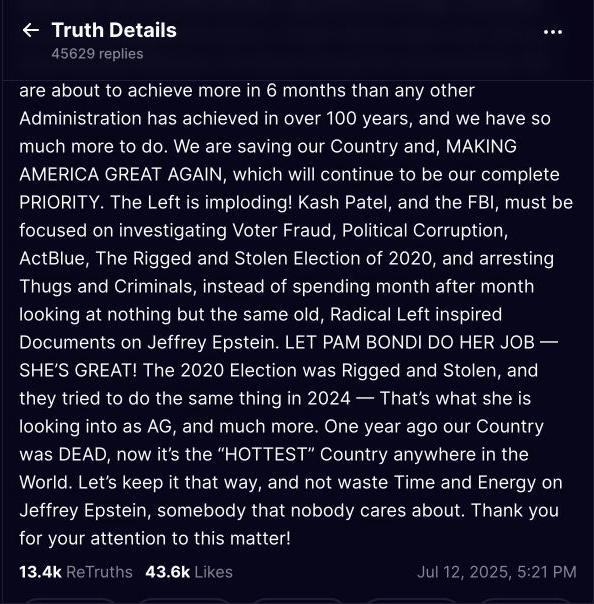
“Don't waste Time and Energy”
Four days later Trump put it in writing, telling his own supporters to drop the subject.
Jul 15–16, 2025
The bill Trump didn't want
Khanna introduced H.R. 4405, the Epstein Files Transparency Act, with Massie as its lead Republican cosponsor. TIME reported that a White House official warned Republicans that supporting the discharge petition would be viewed as “a very hostile act.” That warning came from an unnamed official, not from Trump's own mouth — the attribution matters, and the receipt is recorded here with it.
Whatever changed later, Trump was not leading the congressional push at its start. His own July posts, above, are the direct evidence of that.
Jul 22, 2025
The House goes home early
With Epstein-file votes consuming the chamber, Speaker Mike Johnson began the August recess a day early. The Associated Press reported that the House was paralyzed by Republican divisions over the issue. An early recess does not prove every member of leadership shared one motive. It did delay the votes.
Sep 23 → Nov 12, 2025
The stalled signature
Democrat Adelita Grijalva won an Arizona special election on September 23 after promising to sign the discharge petition that would force H.R. 4405 onto the floor. The House did not swear her in for seven weeks. AP reported that Johnson's delay drew accusations he was blocking the petition's final signature; Johnson said the timing was tied to the government shutdown. The competing explanation belongs in the receipt — this node is marked disputed for that reason.
What is not disputed is what happened when she was finally seated.
Nov 16, 2025
The reversal
Four days after the decisive signature, Trump's public position flipped.
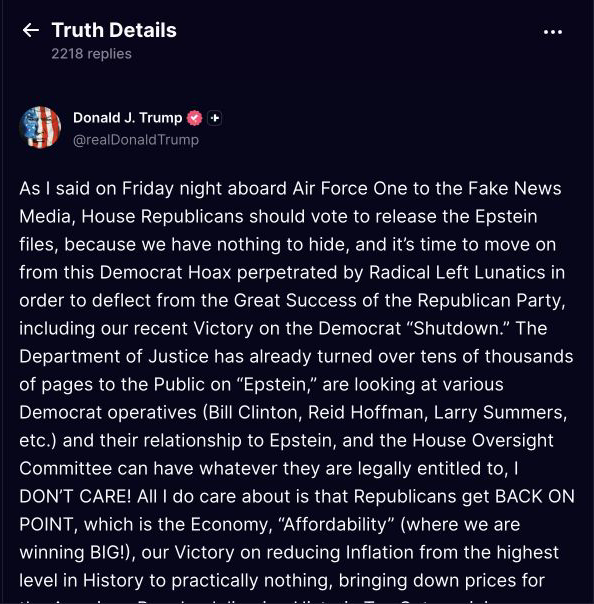
Nov 17, 2025
The votes were already there
Why the timing matters, in the Associated Press's own words:
Nov 18–19, 2025
427–1, unanimous consent, and a quiet signature
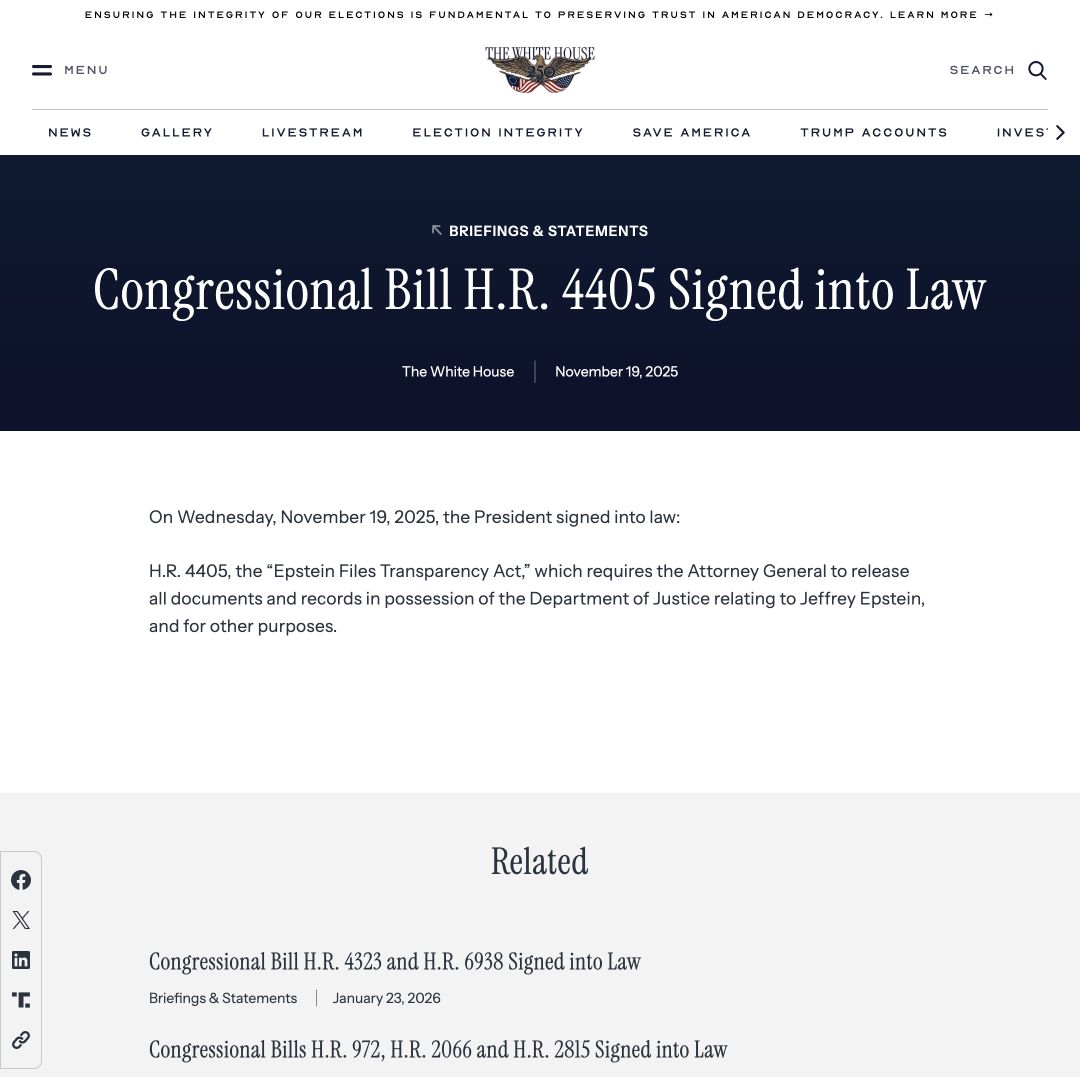
The House passed H.R. 4405 by 427 votes to 1. The Senate passed it by unanimous consent the next day. Trump signed it on November 19 — no public ceremony, no sponsors invited. It became Public Law 119-38.
Jan 30, 2026 → ongoing
The compliance fight
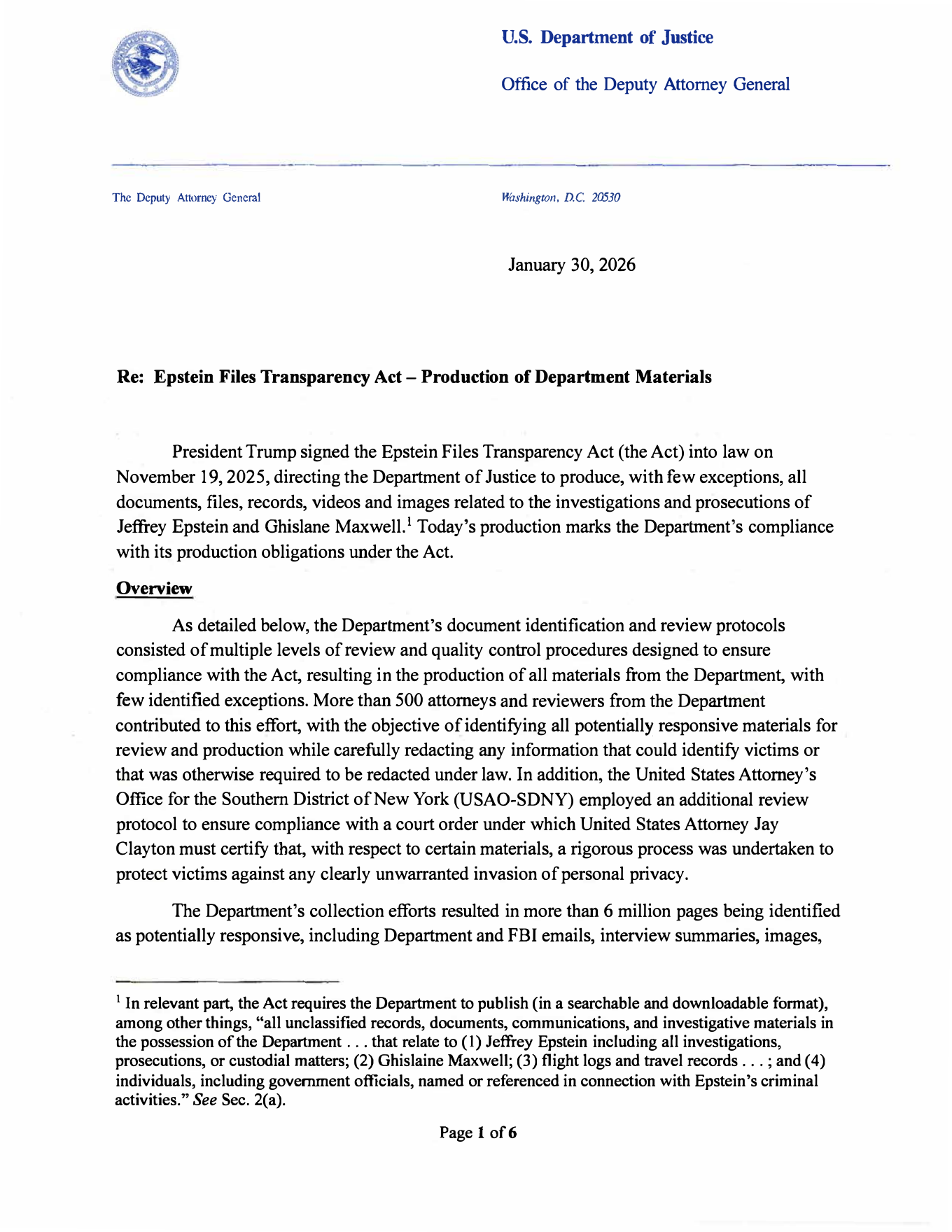
Passing the law was not the end of the story. DOJ told Congress it had identified more than six million potentially responsive pages and released nearly 3.5 million. The sponsors say the withholdings violate the act. This node is open.
That is the trail. Promise, performance, closure, dismissal, blockade, break, reversal, landslide, quiet signature, disputed compliance. Each link above goes to the primary record, not to someone's description of it.
The signing receipt
Massie told Breaking Points that he asked to attend the signing, was not invited, and learned the bill had been signed after the fact. He contrasted that treatment with the usual practice of inviting a bill's sponsors to a public ceremony.
Here is what can be established from outside his account: the White House published a two-sentence notice — shown in the trail above — there was no public ceremony, and Trump announced the signing on social media afterward.
So “secret” is too broad. No public ceremony is precise.
Massie's exclusion is relevant evidence of the relationship between the White House and the bill's lead Republican sponsor. It is not, by itself, proof of why Trump signed.
The stronger argument does not need the word “secret.” The sequence already speaks.
Six million pages are not six million documents
The Breaking Points conversation moves from passage of the law to whether the Justice Department actually followed it. This is where a unit error changes the story.
Vance referred to six million documents. DOJ's number is more than six million potentially responsive pages.
DOJ says it released nearly 3.5 million pages. That leaves a large numerical gap, but the subtraction alone does not prove that every other page is being illegally hidden.
The department says the larger collection included duplicates, nonresponsive material, legally protected victim information, court-controlled records, and privileged material. Its Section 3 report specifically identifies deliberative-process, attorney-work-product, and attorney-client privileges among its withholdings.
Khanna and Massie argue those common-law privileges were not authorized by the act's enumerated exceptions. Their January 30 letter to DOJ challenges the department's compliance.
DOJ says it complied. The sponsors say it did not. The Justice Department inspector general is auditing that question.
The honest receipt says disputed, not “case closed” in either direction.
Why Khanna and Massie introduced a second bill
The day before the interview, Khanna and Massie announced the Epstein Files Transparency Act II.
According to Massie's official summary, the proposal would:
- give survivors, state attorneys general, and members of Congress standing to enforce the first act;
- give survivors access to their own FBI FD-302 interview reports;
- create a path for state prosecutors to obtain relevant records; and
- expressly prevent DOJ from using the common-law privileges now in dispute.
That bill is evidence of an unresolved enforcement problem. It is not evidence that Congress has already won the legal argument. It is a proposal, not current law.
The distinction matters.
The other claims in the interview
The conversation moves fast. Several consequential claims deserve their own status rather than being blended into one theory.
| Claim | Receipt status |
|---|---|
| New Mexico reopened its investigation into Zorro Ranch. | Established. The state DOJ announced the reopened investigation. It is seeking federal material. A reopened investigation is not a new criminal finding. |
| Howard Lutnick visited Epstein's island in 2012 with his family. | Established with limits. Lutnick acknowledged the visit in congressional testimony, contradicting the impression that he cut Epstein off after 2005. AP covered the testimony. A visit does not prove participation in a crime. |
| Epstein worked for a foreign intelligence service. | Unsupported as stated. Records show access to powerful officials and efforts to monetize influence. They do not, on the public evidence reviewed here, prove agency control or employment. |
| Epstein was murdered. | Unresolved allegation, contrary to the official finding. Massie stated his personal belief. The DOJ/FBI position remains suicide. Belief and institutional distrust are not affirmative homicide evidence. |
| The Iran conflict was launched to distract from Epstein. | Unsupported. Khanna rejected a direct causal theory in the interview. Timing and political benefit do not establish causation. |
This is why receipts matter. A documented island visit, a disputed withholding, a political reversal, and an intelligence allegation do not all carry the same evidentiary weight. A viral feed flattens them. A source ledger does not.
What the record says—and what it cannot say
The record supports a straightforward conclusion:
- The administration opened 2025 promising disclosure — “sitting on my desk,” a directive from Trump.
- The staged February release largely repackaged material that had already leaked, by DOJ's own description.
- By July, DOJ and FBI tried to close the disclosure fight entirely.
- Trump publicly dismissed the issue and told supporters to drop it.
- House procedure delayed the effort for months.
- The discharge petition reached 218 the day its final signer was seated.
- Trump reversed after a floor vote became inevitable — and after the votes to pass it were already there.
- Congress passed the bill 427–1 and by unanimous consent; Trump signed with no public ceremony.
- Whether DOJ has actually complied with the law is disputed and under audit.
That is more than a meme. It is a documented sequence you can watch.
It still does not tell us why Trump resisted. It does not prove blackmail. It does not establish foreign-intelligence control. It does not turn every named person into a criminal. It does not settle whether every DOJ withholding complied with the statute.
Those limits do not weaken the receipts. They are part of them.
Vance described the last legal choice. Massie and Khanna described the fight that made continued resistance politically costly.
The narrative changed. The receipts did not.
The primary records
Every claim above traces to one of these. Skip the commentary and read them yourself.
- DOJ/FBI memorandum, July 7, 2025 — “no further disclosure would be appropriate or warranted”
- DOJ press release on the “Phase One” binders, Feb. 27, 2025
- Trump's July 12, 2025 Truth Social post (archived transcript)
- House Clerk discharge petition record — signature 218, Nov. 12, 2025
- Trump's November 16, 2025 Truth Social post
- House roll call: 427–1
- Congress.gov: H.R. 4405 complete action history
- White House signing notice, Nov. 19, 2025
- DOJ compliance release, Jan. 30, 2026 and Section 3 report
- Khanna–Massie letter to the deputy attorney general, Jan. 30, 2026
- DOJ inspector general compliance audit (ongoing)
Next Step
Keep moving
Related reading
Maryland's Primary: Everyone Counted the Money. Nobody Read the Map.
The 2026 Maryland primary got reported as "the establishment held." That's true and it's the least interesting thing that happened. Read the map instead of the topline and you find a quiet handoff of executive power to Maryland's Black political class — across the populous core of the state, in a single night, with almost none of it counting as an upset.
The Largest IPO in History Is Already Underwater. Here's What They're Still Not Saying.
Five weeks after the biggest IPO ever, SPCX trades below its offer price. The real story is still everything else — Anthropic's $1.25B/month rent checks, Grok firing missiles through the Pentagon's Maven system, the CSAM lawsuit expanding, and the 19-day government shutdown of Claude's best models.
Tacemus
Need a clearer digital system?
Tacemus helps silent builders turn signal into websites, automations, and AI-backed workflows that actually move the business.